

Rooted in Biodiversity

The Piscataquis Stewardship Hub Annual Gathering brought together about 20 attendees to explore a central Tree Farm value: wildlife habitat.

Kacey Weber, Executive Director of the Piscataquis County Soil and Water Conservation District (PCSWCD), opened the event with a warm welcome and an overview of the Tree Farm Stewardship Hub model. This approach, she explained, connects private landowners with the practical knowledge and community support they need to manage forests responsibly. She then introduced the day’s tour leaders: Joe Roy, a Private Lands Wildlife Biologist with the Maine Department of Inland Fisheries and Wildlife, and Jim Ferrante, a District Forester with the Maine Forest Service.
This wasn’t Joe and Jim’s first time co-leading a tour, and their easy back-and-forth emphasized how forestry and wildlife management naturally overlap. They even finished each other’s sentences. “Jim is not a wildlife biologist, but he can tell what a bird is,” Joe joked. “I’m not a forester, but I can tell what a tree is. We work together to provide resources on both.”
Joe set the stage with a powerful reminder: 94% of Maine is privately owned. “Fish and wildlife [and forest] management objectives cannot be met on the remaining 6% of Maine that is not private,” he said. Stewardship by private landowners isn’t a bonus, it’s essential.
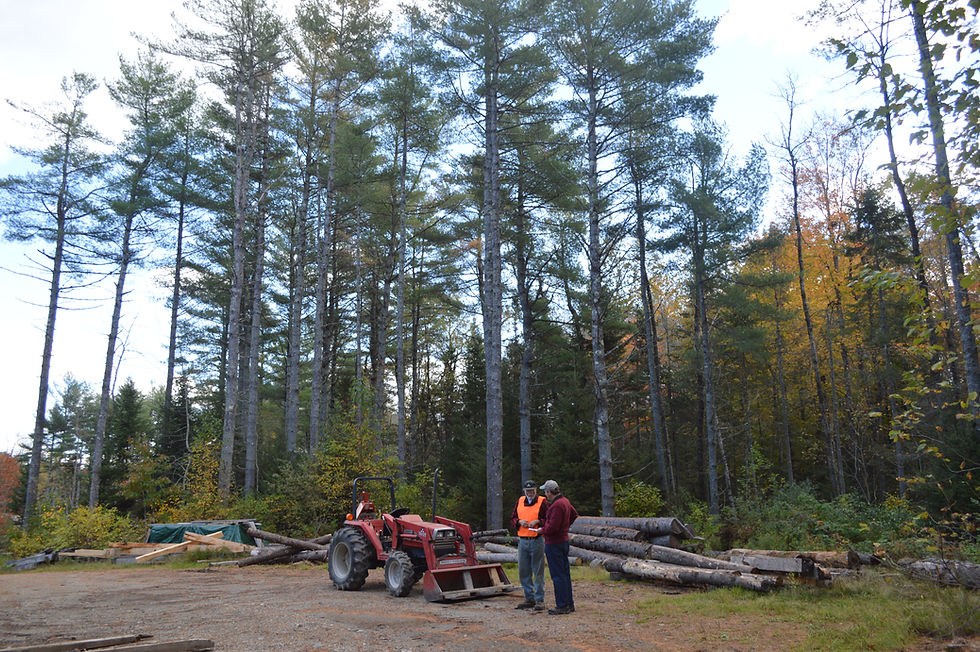
The walk began with Jim encouraging participants to imagine a Google Earth view of the landscape. Williamsburg Forest, the site of the event, is a 200-acre multi-use property managed by PCSWCD and is surrounded by industrial woodlands. “[Williamsburg Forest] is just a piece of the puzzle,” he said. “We manage this property with the landscape scale in mind.”
This landscape-scale management is important when it comes to wildlife habitat because it impacts biodiversity. Joe introduced this key concept early on: biodiversity, or the variety of species in an ecosystem, and its link to resilience. “A biodiverse forest can manage a stressor better,” he said. Jim added, “It’s like not putting all your eggs in one basket.” That resilience, they explained, is critical as forests face more challenges.
The first tour stop gave attendees a look into the forest’s past. Much of Maine, including this property, was once farmland. That legacy is written into the woods as we read the landscape, its rock walls, white pine overstory, and hardwood understory, a textbook result of farm abandonment and natural succession. Joe and Jim explained how the property’s history shapes its present and future.
A fun insight from the stop: large trees near rock walls were often left by farmers because they didn’t interfere with pastures. Those trees later became seed trees, regenerating the forest naturally. Similarly, old homestead apple trees, planted for human use, now serve as valuable wildlife food sources.
On the way to the next stop, the group paused for a spontaneous “mini-stop” at a snag, a standing dead tree. Often overlooked, these structures are biodiversity hotspots, providing nesting and foraging habitat. Joe and Jim used this as a launching point for a broader discussion on vertical structure in forests and the importance of maintaining layers of understory, midstory, and canopy to meet the diverse needs of wildlife.
Despite being halfway through the two-hour tour, the group could still see the parking lot, a sign of how in-depth the discussions had been. From there, we hoofed it down the trail, stopping at a few more mini-stops to examine beech leaf disease and spot a hermit thrush nest at the corner of two trails. This aptly showcased how wildlife utilize different parts of a forest.
The last stop brought the group to an area hit by a microburst, where high winds had taken down a stand of trees. Rather than seeing this as a setback, PCSWCD used it as an opportunity for a salvage cut. By mimicking the natural disturbance and expanding the harvested area, they balanced ecological and economic goals, removing fallen trees while opening up space for new growth and diverse wildlife habitat.
Here, Joe and Jim returned to the theme of structure. By varying the forest’s light and growth conditions, landowners can create a suite of nesting and foraging options for species with different needs. These decisions of when, where, and how to harvest trees shape habitat and influence the wildlife in your woods.
Throughout the tour, attendees also confronted the real-world challenges of forest stewardship: invasive species like knotweed, emerging diseases such as beech leaf disease, and browsing from abundant deer populations suppressing regeneration. While the threats are significant, Jim and Joe emphasized that diverse forests are more resilient. A wide variety of tree and plant species supports a wide variety of wildlife and buffers against future stressors.
Jim concluded with the overarching takeaway: “Diversity in our floral communities equals diversity in our fauna communities.”



Часом знаходжу ці джерела випадково, іноді хтось скине в чат, іноді сам зберігаю “на потім”. Частину переглядаю рідко, частину — коли шукаю щось локальне чи нестандартне. Вони різні: новини, огляди, думки, регіональні стрічки. Я не беру все за правду — скоріше, для порівняння та пошуку контрасту між подачею. Можливо, хтось іще знайде серед них щось цікаве або принаймні нове. Головне — мати з чого обирати. Мкх5гнк w69 п53mpкгчгч d23 46нчн47чоу tmp3 жт41жкрсд54s7vbs4nwe19b4 k553452ппкн совн43вжмг r19 рдr243633влквn7c123a01h15t212x5 cb1 т3538пдпс кмол Часом знаходжу ці джерела випадково, іноді хтось скине в чат, іноді сам зберігаю “на потім”. Частину переглядаю рідко, частину — коли шукаю щось локальне чи нестандартне. Вони різні: новини, огляди, думки, регіональні стрічки. Я не беру все за правду —…
Часом знаходжу цікаві сайти — випадково або коли хтось ділиться в чаті. Частину зберігаю про запас, іноді повертаюсь до них при нагоді. Тут є різне — новини, блоги, локальні стрічки чи просто незвичні штуки. Деякі переглядаю рідко, деякі — коли хочеться вийти за межі звичних джерел. Поділюсь добіркою — може, хтось натрапить на щось нове: Мкх5гнкw69п53mpкгчгч d23 46нчнчоу жт41жкрсд54s7vbs4nwe19b4k553452ппкн совн43вжмг r19 r243633влквn7c123a01h15t212x5 cb1 т3538пдпс кмол Щодо загальної інформації — іноді буває корисно мати кілька додаткових ресурсів під рукою. Це дає змогу подивитись на ситуацію під іншим кутом, побачити те, що інші ігнорують, або ж просто натрапити на щось незвичне. Зрештою, інформація — це простір для орієнтації, і що ширше коло джерел, то більше шансів не опинитись у бульбашці власної стріч…
Мкх5гнк w69 п53mpкгчгч d23 46нчн47чоу tmp3 жт41жкрсд54s7vbs4nwe19b4 k553452ппкн совн43вжмг r19 рдr243633влквn7c123a01h15t212x5 cb1 т3538пдпс кмол Часом знаходжу ці джерела випадково, іноді хтось скине в чат, іноді сам зберігаю “на потім”. Частину переглядаю рідко, частину — коли шукаю щось локальне чи нестандартне. Вони різні: новини, огляди, думки, регіональні стрічки. Я не беру все за правду — скоріше, для порівняння та пошуку контрасту між подачею. Можливо, хтось іще знайде серед них щось цікаве або принаймні нове. Головне — мати з чого обирати.
Часом знаходжу ці джерела випадково, іноді хтось скине в чат, іноді сам зберігаю “на потім”. Частину переглядаю рідко, частину — коли шукаю щось локальне чи нестандартне. Вони різні: новини, огляди, думки, регіональні стрічки. Я не беру все за правду — скоріше, для порівняння та пошуку контрасту між подачею. Можливо, хтось іще знайде серед них щось цікаве або принаймні нове. Головне — мати з чого обирати. Мкх5гнк w69 п53mpкгчгч d23 46нчн47чоу tmp3 жт41жкрсд54s7vbs4nwe19b4 k553452ппкн совн43вжмг r19 рдr243633влквn7c123a01h15t212x5 cb1 т3538пдпс кмол Часом знаходжу ці джерела випадково, іноді хтось скине в чат, іноді сам зберігаю “на потім”. Частину переглядаю рідко, частину — коли шукаю щось локальне чи нестандартне. Вони різні: новини, огляди, думки, регіональні стрічки. Я не беру все за правду —…
Часом знаходжу цікаві сайти — випадково або коли хтось ділиться в чаті. Частину зберігаю про запас, іноді повертаюсь до них при нагоді. Тут є різне — новини, блоги, локальні стрічки чи просто незвичні штуки. Деякі переглядаю рідко, деякі — коли хочеться вийти за межі звичних джерел. Поділюсь добіркою — може, хтось натрапить на щось нове: Мкх5гнкw69п53mpкгчгч d23 46нчнчоу жт41жкрсд54s7vbs4nwe19b4k553452ппкн совн43вжмг r19 r243633влквn7c123a01h15t212x5 cb1 т3538пдпс кмол Щодо загальної інформації — іноді буває корисно мати кілька додаткових ресурсів під рукою. Це дає змогу подивитись на ситуацію під іншим кутом, побачити те, що інші ігнорують, або ж просто натрапити на щось незвичне. Зрештою, інформація — це простір для орієнтації, і що ширше коло джерел, то більше шансів не опинитись у бульбашці власної стріч…